How the Global Mayors Academy is reimagining leadership as a shared capacity to help cities learn, cooperate, and regenerate
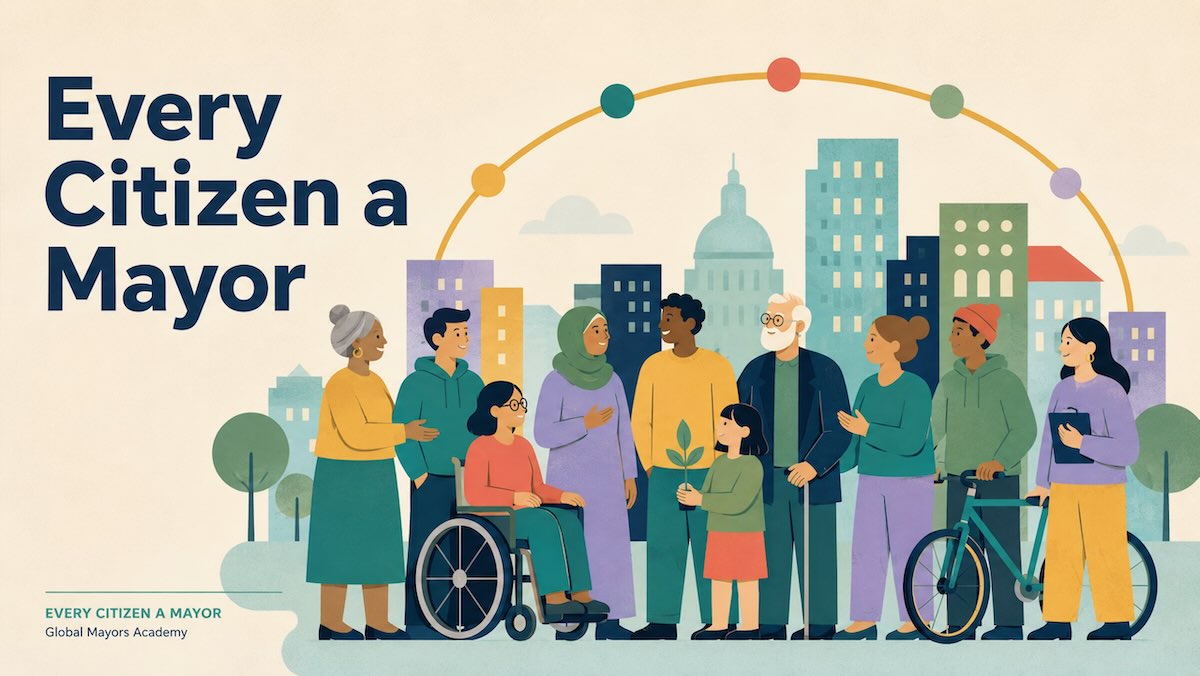
“We call it the Global Mayors Academy, but essentially, it is about seeing every person in that city as the mayor.”
With those words, Ferial Puren, CEO of Global Mayors Academy offers a radically different vision of civic leadership.
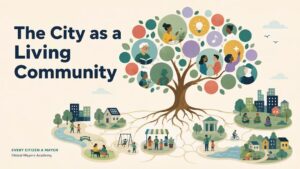
The mayor still has an essential role. So do municipal administrations, educators, civic organizations, businesses, neighborhood leaders, and community members. But no single person or institution can carry the complexity of an entire city.
The Global Mayors Academy begins with a simple premise:
the well-being of a city must become a shared responsibility.
To become a “mayor” in this sense does not require holding public office. It means becoming a steward of the whole—someone willing to listen, learn, cooperate, and contribute to the flourishing of the place they call home.
The city as a living community
Ferial began our conversation with a greeting she learned growing up in Africa:
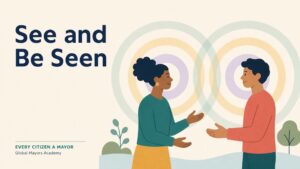
Sawubona — I see you.
As she explained it, “I see you” means more than acknowledging the person standing before us. It means recognizing the generations, relationships, experiences, and inheritances that have shaped them.
The response is Sikhona — I make myself available to be seen.
This exchange captures something essential about the Academy’s approach. Before leaders can transform systems, they must learn to see and be seen. They must listen beyond titles, positions, and assumptions and enter into genuine relationship with the people they serve.
The city is not simply a machine to be managed or a collection of problems to be solved. It is a living community with its own intelligence, memory, creativity, wounds, and unrealized possibilities.
The work of leadership is not to arrive with every answer. It is to help the city hear itself.
Better tools are not enough
Cities everywhere are confronting overlapping challenges:
social fragmentation, economic inequality, climate disruption, declining public trust, technological change, and increasing polarization.
Mayors and civic leaders are expected to respond quickly and confidently, even when the problems extend far beyond the authority or capacity of any one administration.
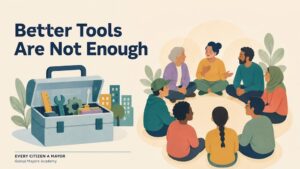
Traditional leadership programs often respond by offering more strategies, technologies, frameworks, and management tools. These resources can be valuable, but they are not enough.
A sophisticated tool placed in the hands of a leader who cannot listen, work across differences, share authority, or admit uncertainty may reinforce the very problems it was meant to solve.
The Global Mayors Academy therefore focuses not only on what leaders know, but on who they are becoming.
How do we nurture compassion rather than merely speak about it?
How do we develop the self-awareness, relational maturity, courage, and humility required for genuine cooperation?
How do leaders learn to remain present when they do not have an answer?
These are not secondary or “soft” leadership questions. They are foundational capacities for navigating complexity.
Transforming the leader and the system
The Academy is developing a whole-person, whole-city approach to leadership.
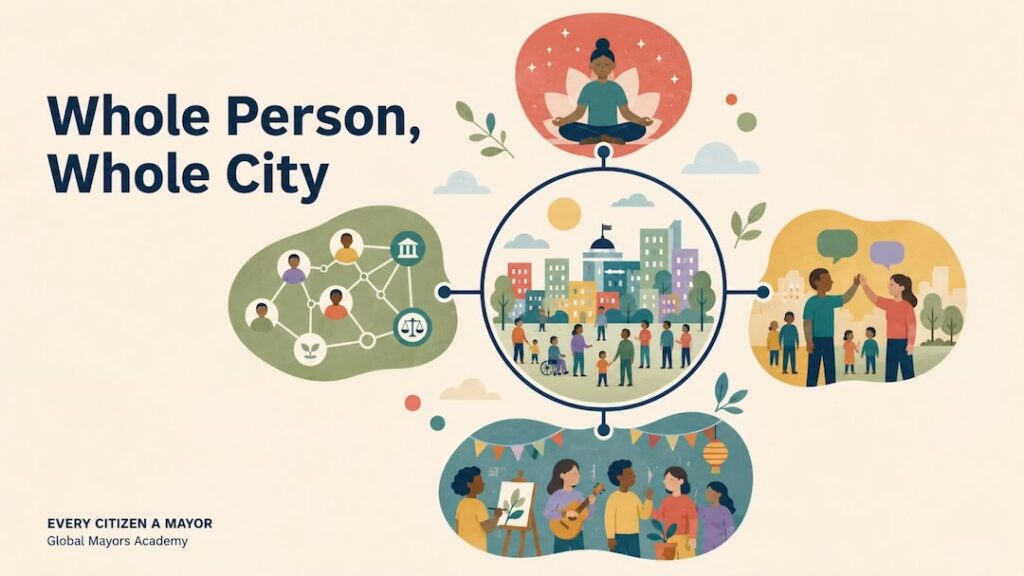
Participants are invited to explore four interconnected dimensions:
their inner world, their outward behavior, the relationships and culture of the collective, and the systems and institutions through which the city operates.
Each dimension matters.
Technical expertise without inner maturity can become control. Personal transformation without civic engagement can remain private. Institutional reform without trust and relationship may never take root.
Regenerative leadership requires these dimensions to develop together.
The Academy is therefore being designed not as a single standardized course, but as an experiential learning journey. Participants examine the mindsets and “heartsets” that shape how they use authority, respond to uncertainty, form relationships, and engage with complexity.
The learning then moves beyond the classroom and into the city itself.
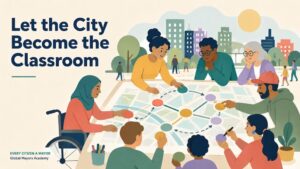
Mayors, administrations, civic leaders, and residents can work together to identify where readiness and creative energy already exist.
Rather than attempting to redesign an entire city at once, they can develop prototypes, test new approaches, reflect on what they learn, and expand what works.
The goal is not for the Academy to fix a city from the outside. It is to help people within the city strengthen their own capacity to listen, cooperate, experiment, and act.
Many forms of knowledge, held together
The Academy is being developed through a growing international learning community connected with Living Cities Earth.
Its contributors bring experience in regenerative development, leadership maturity, compassionate cities, participatory governance, systems thinking, cooperation, embodied learning, and whole-city practice.
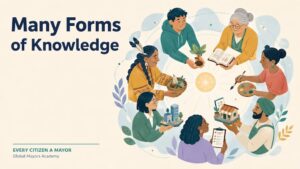
The Global Mayors Academy(GMA) was born from the vision of Lev Gordon, who first conceived the idea of creating a transformational learning journey for city leaders. Together with Ferial Puren, who was invited to the Global Mayors Academy as CEO, they assembled an extraordinary international team of more than 70 educators, researchers, practitioners, and city transformation leaders to co-create and deliver the Academy.
Leading the curriculum design is Dr. Paddy Pampallis, whose 26 years of experience in developing integral learning journeys and educational programs forms the foundation of the Academy's learning experience. The Academy's core design team also includes Dr. Anneloes Smitsman, Dr. Pavel Luksha, and Nathaniel (Nate) Whitestone, whose combined expertise spans regenerative development, systems thinking, future learning, leadership, governance, and whole-city transformation.
Supported by the decades of pioneering work of contributors including Dr. Marilyn Hamilton, renowned for her Integral City work; Sue Cooper, connecting the Academy with the Charter for Compassion; Dr. Alexander Laszlo, contributing his work on syntony and collaboration; and many other esteemed educators, facilitators, civic practitioners from around the world, the GMA brings together one of the most diverse collaborative learning teams dedicated to helping cities and their leaders thrive.
Their collaboration reflects one of the Academy’s central beliefs:
no single expert, organization, or methodology is sufficient for the complexity of a city.
The wisdom is in the relationships among them.
The same principle applies within a community. Residents possess knowledge that municipal institutions may not have.
Young people, elders, artists, business owners, Indigenous leaders, educators, faith communities, neighborhood organizers, and public servants each see different parts of the whole.
Diversity is not an obstacle to overcome. It is a source of resilience, intelligence, and possibility.
Unity does not require everyone to think or live in the same way. It requires developing the capacity to remain in relationship, learn from difference, and act together for the well-being of the whole.
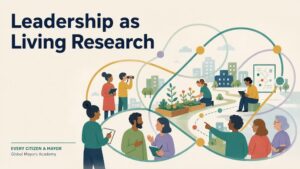
Leadership as a living research project
Ferial describes the Academy as a research project.
“How do we learn to do this better?” she asks. “We don’t know how to do this. We have some ideas that are really good.”
That humility does not diminish the Academy’s ambition. It makes the work more credible.
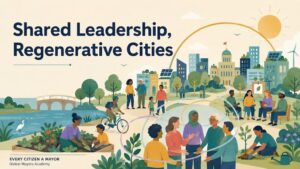
No one has a complete blueprint for the social, ecological, and technological future now emerging.
Cities must become capable of learning in real time—sensing what is changing, drawing upon the intelligence of their communities, experimenting responsibly, and adapting together.
In this way, the Academy is not simply preparing people to lead cities. It is helping cities become intentional learning communities.
From compassionate cities to cities that practice compassion
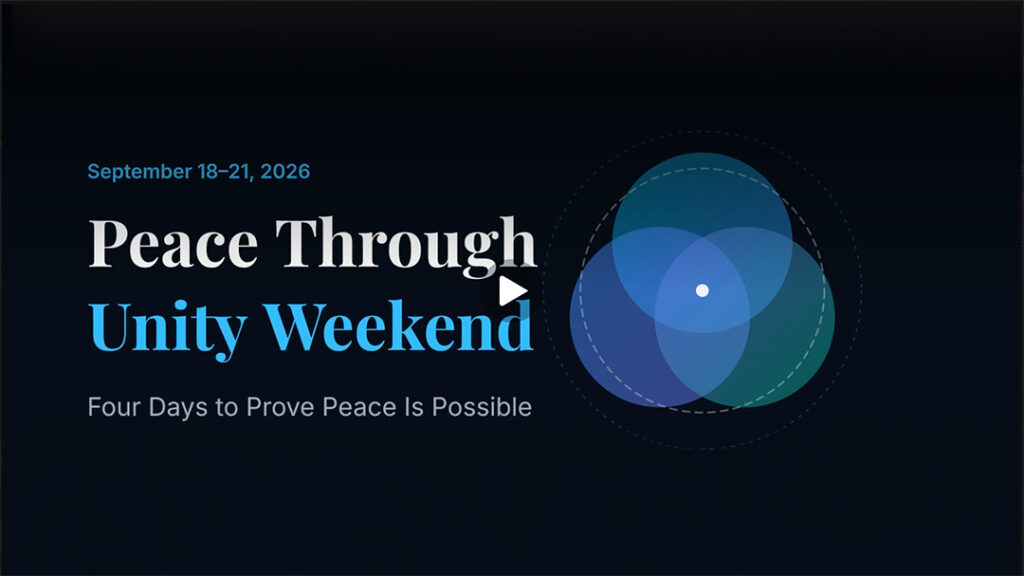
This vision also creates a natural connection with the Compassion Games and the growing Peace Through Unity movement.
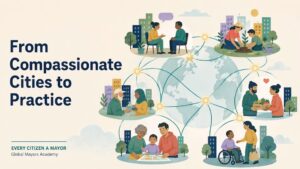
A city can declare its commitment to compassion, peace, or regeneration.
The deeper question is how those commitments become visible in daily life.
How do people practice compassion across political and cultural differences?
How do residents participate meaningfully in shaping their city?
How do institutions share responsibility rather than protect their silos?
How do communities learn from what succeeds and what fails?
Compassion Games can offer participating cities a field for putting these principles into action. Academy participants could organize local challenges, develop community prototypes, report what they learn, and share their stories with cities around the world.
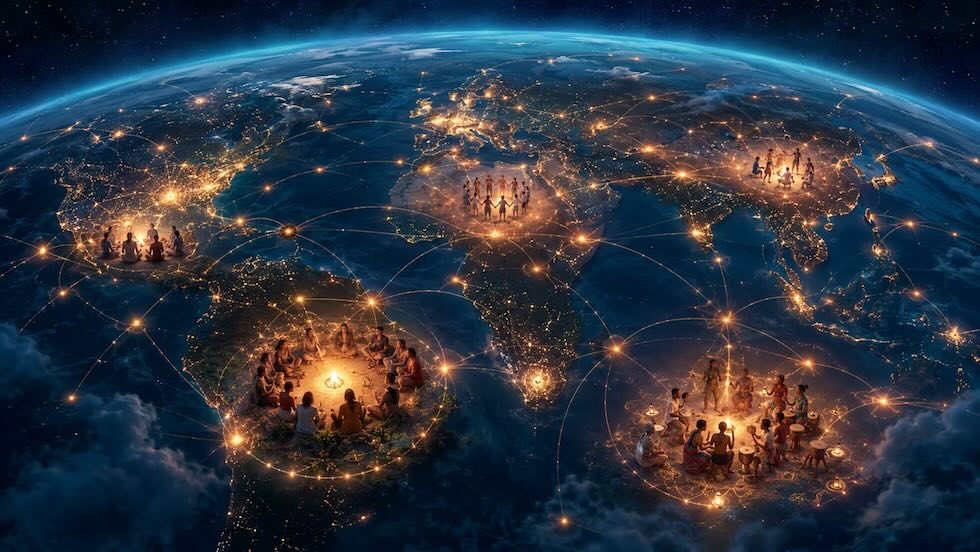
Cities could also become Peace Nodes—locally rooted communities connected through a wider global movement for cooperation, healing, and peace.
The pattern is powerful:
Inner development makes deeper relationship possible.
Relationship makes cooperation possible.
Cooperation makes shared action possible.
Shared action makes regeneration possible.
Let the city become the classroom
The Global Mayors Academy invites us to expand our understanding of who leads a city.
Leadership is not something one heroic person carries on behalf of everyone else. It is a capacity that can be cultivated throughout a community.
What might become possible if leadership development were not reserved for elected officials?
What if residents were invited to see themselves as stewards of the whole?
What if cities became places where people learned not only how to live beside one another, but how to listen, cooperate, repair harm, and shape their future together?
The invitation is not to arrive with a finished answer.
It is to enter a shared journey:
See one another.
Listen to the city.
Invite every voice.
Practice cooperation.
Prototype what is possible.
Learn from what happens.
Share what changes.
No mayor can regenerate a city alone. No organization can create peace by itself. But when leadership becomes a shared capacity, the city can become something more than a government, an economy, or a collection of buildings.